Trading · Investing · Portfolio · Education — one workspace

Ten tabs open is not a strategy.

AlphaNova is one app and one interface for the whole job: find the idea, test it, size it, place it, automate the stop, manage your book risk, and understand every step. Built by a trader who got tired of the acrobatics, and built so his friends and family could use it too.

Private: no sign-up, no subscription, nothing for sale Education and decision support, not financial advice Nothing trades your real money on its own
app.alphanovainvest.com/#market/pulselive · after-hours
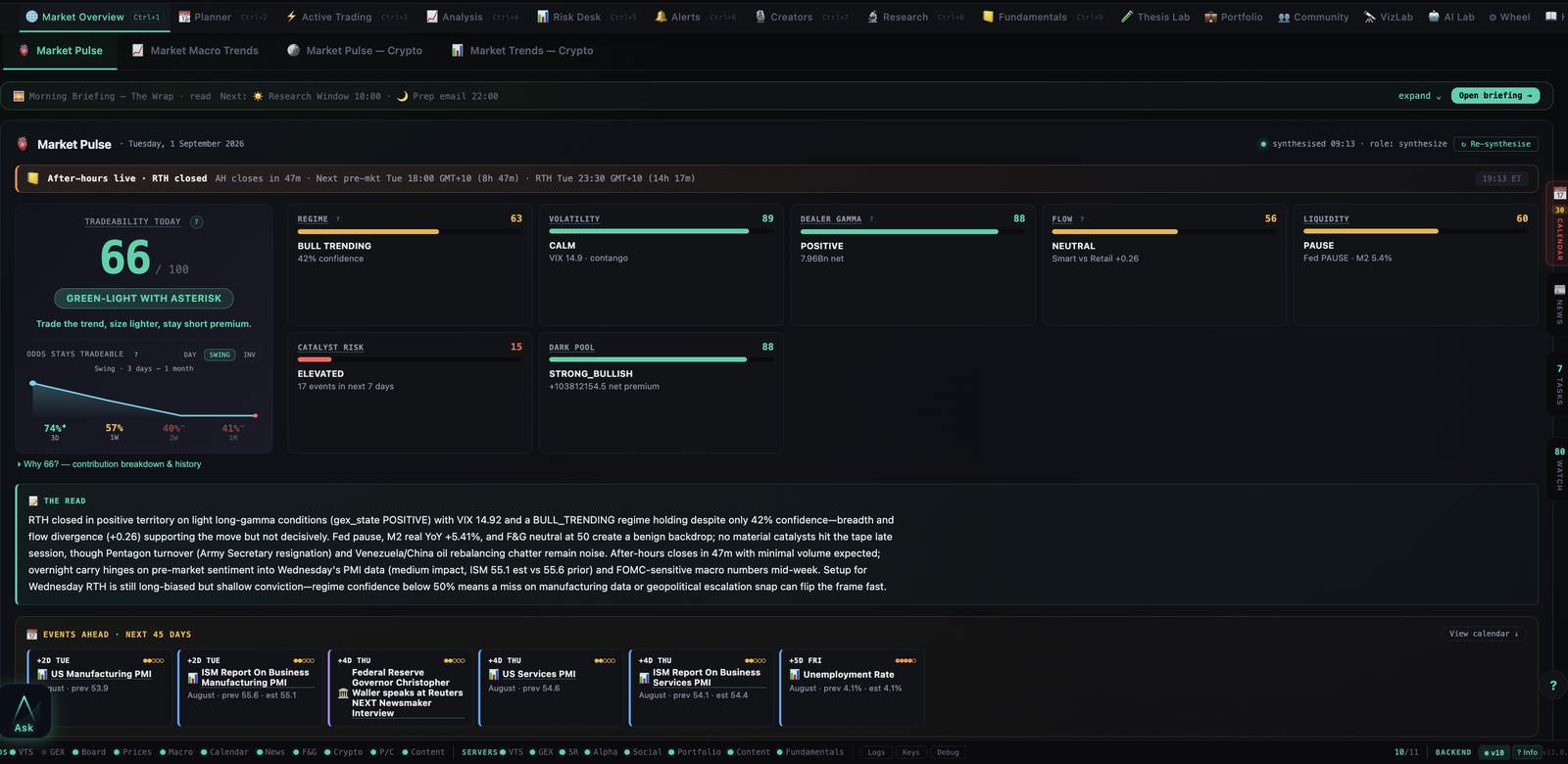
REGIME BULL TRENDING VIX 14.9 SPX GEX POSITIVE ZONE GREEN · OWN F&G 50 FLOW ALIGNED CATALYSTS 17 in 7d
Tradeability today
66/100
GREEN-LIGHT WITH ASTERISK
Trade the trend, size lighter, stay short premium.
Regime63
BULL TRENDING
42% confidence
Volatility89
CALM
VIX 14.9 · contango
Dealer gamma88
POSITIVE
7.96Bn net
Flow56
NEUTRAL
smart vs retail +0.26
Liquidity60
PAUSE
Fed pause · M2 +5.4%
Catalyst risk15
ELEVATED
17 events in 7 days
The read · synthesised 09:13
RTH closed in positive territory on light long-gamma conditions with a bull-trending regime holding at only 42% confidence. Fed pause, real M2 +5.4% and neutral sentiment make a benign backdrop. Wednesday hinges on PMI. Long-biased, shallow conviction: a miss on manufacturing data can flip the frame fast.
19
workspaces, one interface
2,650
tickers scanned each session
2,658
ideas tracked to outcome since Apr 2026
74
plain-English help articles, plus a living FAQ
400K
lines of product code, 11,000 automated tests
13
data feeds, one screen

The friction we removed

Learning to trade shouldn't start with a scavenger hunt for tools.

Most people who start trading properly spend their first months not learning markets but wiring up software: a scanner here, a charting subscription there, an options tool, a broker that talks to none of them, a spreadsheet for the portfolio, and a YouTube feed for ideas. That trial-and-error is expensive, it is tedious, and it puts good people off.

AlphaNova collapses the technical and logistical acrobatics into one place. Ideation, analysis, trade setup, execution, automated stops and book risk, all in one interface, all talking to each other.

Scanner — 12 alertsCharting — Pro planOptions chainBroker (session expired)Portfolio.xlsxDark pool feedYouTube — 47 minDiscord #callsMacro dashboardStops? (browser closed)
One app · one interface · one login
▲ AlphaNovaidea → evidence → size → order → stop → review

One pane of glass

The whole trade, in the order you actually do it.

Every workspace sits on one of six stages. You never leave the app, and nothing gets lost between the idea and the review.

Ideation

Alpha is surfaced from a dozen independent sources and scored by how many agree.

Alpha IdeasCreatorsThemesSocialDark pool

Analysis

Every idea shows its evidence on the chart. Fundamentals, calls and a thesis you can try to break.

Evidence layerFundamentalsThesis LabOptions

Setup

Size by equal risk per idea, stage it, and see what it does to the book before you commit.

Risk DeskPipelineAllocator

Execute

Paper and live side by side, never the default. Caps enforced on the server. Red-team the order first.

Alpaca paper · liveOptions ticket

Protect

Stops arm on fill, on the server, with your laptop closed. Drag the stop and the broker order moves.

GuardianStop ladderAlerts

Review

The whole journey on one chart, the edge cloud of every idea, and rituals anchored to real dates.

Trade JourneyEdge CloudPlannerTax Centre

Why it compounds

The moat is the loop, not the parts.

Regime informs scoring. Scoring sets stops. Stops feed the lifecycle. Resolved P&L trains the tuner, and the tuner re-weights scoring. Charting tools, flow feeds, scanners and research terminals each own one piece. None of them close the loop, so none of them can tell you whether you have an edge.

  • REGIMESix market regimes, a whipsaw buffer, and a separate R1–R4 risk posture. Strategy fit and risk posture are different axes and are named as such.
  • SCOREIdeas are scored by independent agreement (structure, gamma, rotation, earnings clearance), not by one indicator.
  • STOPSServer-side, tighten-only overlays keyed to the strategy and the regime.
  • LIFECYCLEEvery idea resolves to an outcome in R, and the outcome is audited in-app.
  • TUNERThe AI tuner proposes weight changes from resolved outcomes. It applies nothing without a human approving it.
REGIME SCORE STOPS LIFECYCLE TUNER resolved P&L in R 2,658 ideas · audited nothing applied without approval

Ideation

Alpha from many sources. Scored by how many agree.

Each session the engine scans the whole universe, runs it through named gates, and ships a short list into your mode (day, swing or investor). Every accept and reject shows its reason.

Stock scanning

The Alpha Engine

Nine strategy scans over 2,650 tickers, gated by regime, earnings, liquidity, gamma and structure, then rescored by content, insiders, dark pool and rotation.

2,650 → 106 → 34 survived · 1 Sep 2026
Technical structure

Evidence, not vibes

Market structure, 50-day slope, overhead supply, candle signal and volume expansion, each stated in plain English on the chart.

"Why this surfaced" on every idea
Sector rotation

Rotation Graph (RRG)

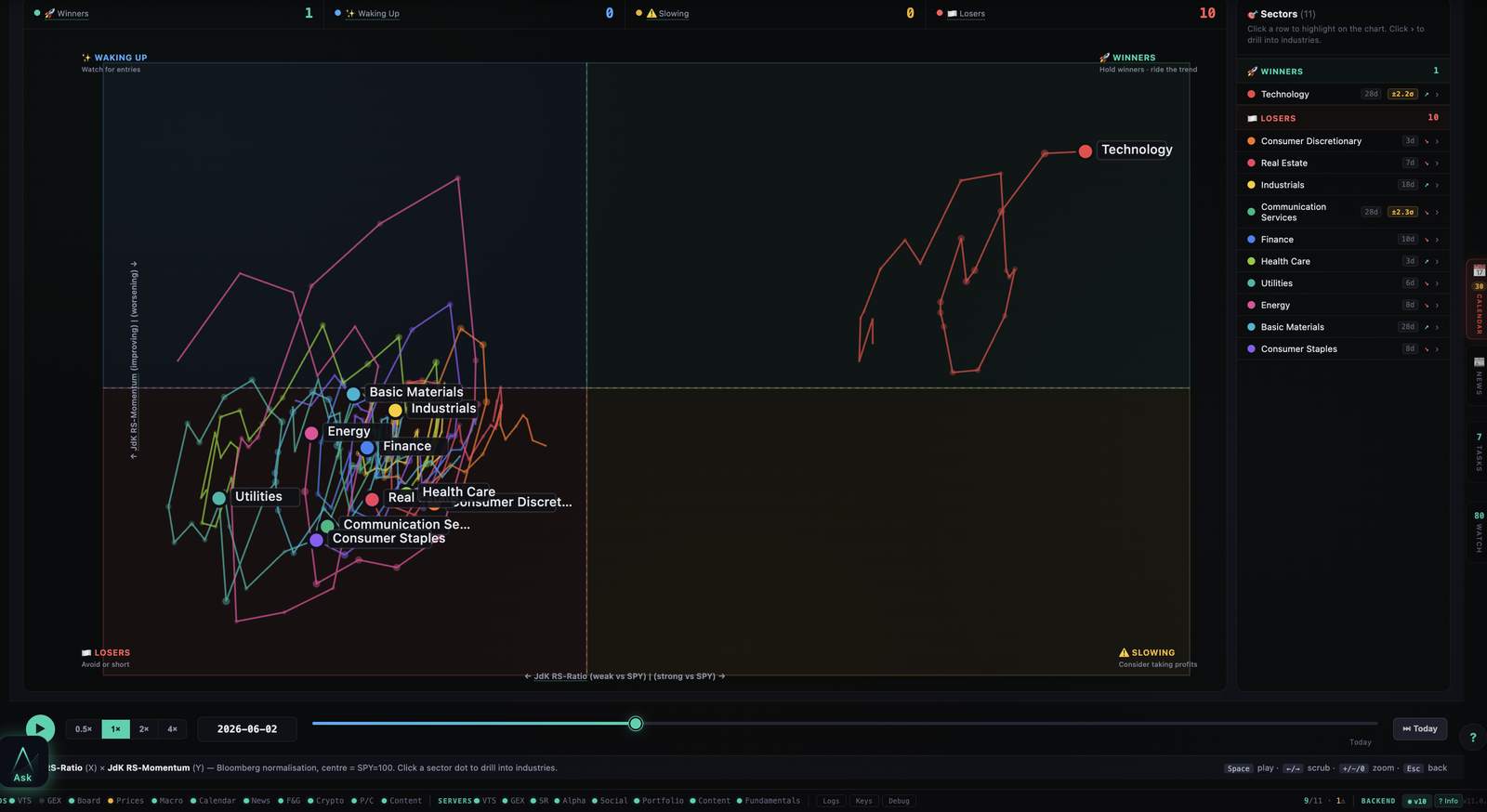
Eleven sectors and 137 industries on a JdK RS-Ratio × RS-Momentum chart, with a 90-day replay and drill-down.

Winners · Waking up · Slowing · Losers
Themes

116 investment themes

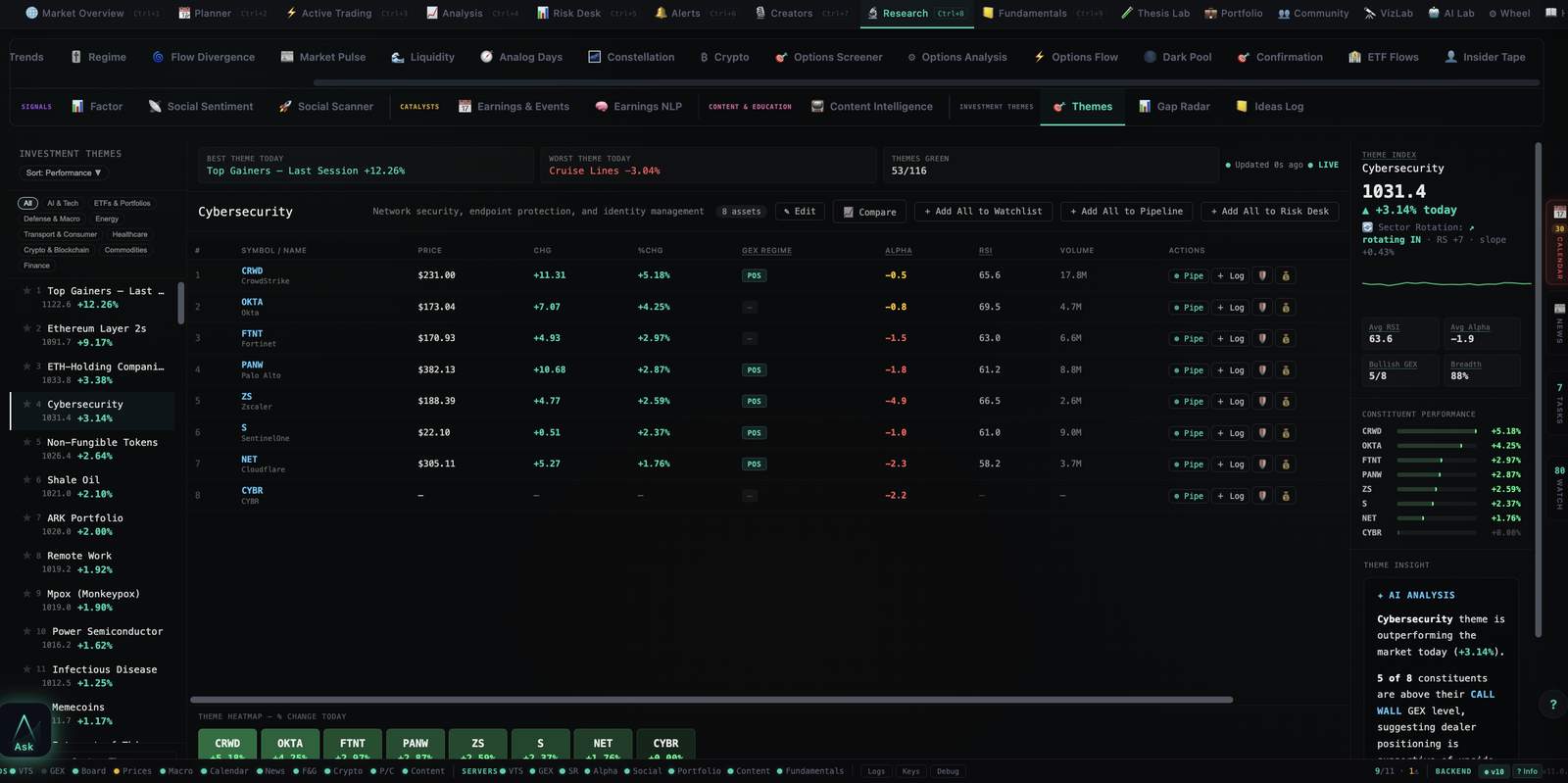
Cybersecurity, shale oil, power semis, Ethereum L2s. Each theme has an index, constituents with GEX regime, and an AI read.

53/116 green · best theme +12.26%
Finance content

Creator alerts

Finance YouTube, transcribed and read by AI. Every directional call is tracked to 1, 3, 7 and 14-day outcomes and the creator earns a 0–100 credibility score.

Promotional content quarantined
Social arbitrage

Social momentum

Google Trends velocity, Reddit mention ratio, sentiment and app-store rank, with a four-phase lifecycle: early, growth, peak, decline.

Alerts on phase transitions
Positioning

Dark pool, options flow, GEX

Dealer gamma by strike, the gamma flip, call and put walls, net dark-pool premium and unusual options flow, per ticker and market-wide.

SHELTER · PIN · MAGNET · CAP levels on the chain
Macro

Regime, liquidity, money supply

Six regimes, Fed cycle (QE / QT / Pause / Stealth QE), global M2 across five economies, CTA positioning, VIX term structure.

M2 vs SPX · BTC vs M2 · Fed cycle
app.alphanovainvest.com/#active-trading · Alpha Engine — Pipeline Flow
The Alpha Engine pipeline flow: a Sankey from 2,650 tickers scanned through strategy scans and gates to 34 ideas shipped in swing mode, with a live ticker feed of accepts and rejects and their reasons.
Pipeline Flow. Width is idea count. The funnel narrows hardest at the gates, which is where hit rate is protected. The right rail streams every accept and reject with its reason.

Inside the workspace

Read the weather. See the evidence. Follow the trade to the end.

Real screens from the live desk. Click any screenshot to enlarge.

Market Overview · Market Pulse

Read the weather before you touch a chart.

One number for the day's tradeability, six dimensions behind it, and an AI-written read that names what would change its mind. The playbook adapts to your mode.

  • Tradeability 0–100 with a verdict tier: CONSTRUCTIVE · GREEN-LIGHT WITH ASTERISK · MIXED · GUARDED · DEFENSIVE
  • Regime, volatility, dealer gamma, flow, liquidity, catalyst risk and dark pool, each with its own explainer.
  • Odds the day stays tradeable at 3d, 1w, 2w and 1m, and the next 45 days of catalysts.
#market/pulse
Market Pulse: Tradeability 66 of 100, verdict Green-light with asterisk, dimension tiles for regime, volatility, dealer gamma, flow, liquidity, catalyst risk and dark pool, and The Read narrative.

Chart · Evidence layer

Every idea shows its work.

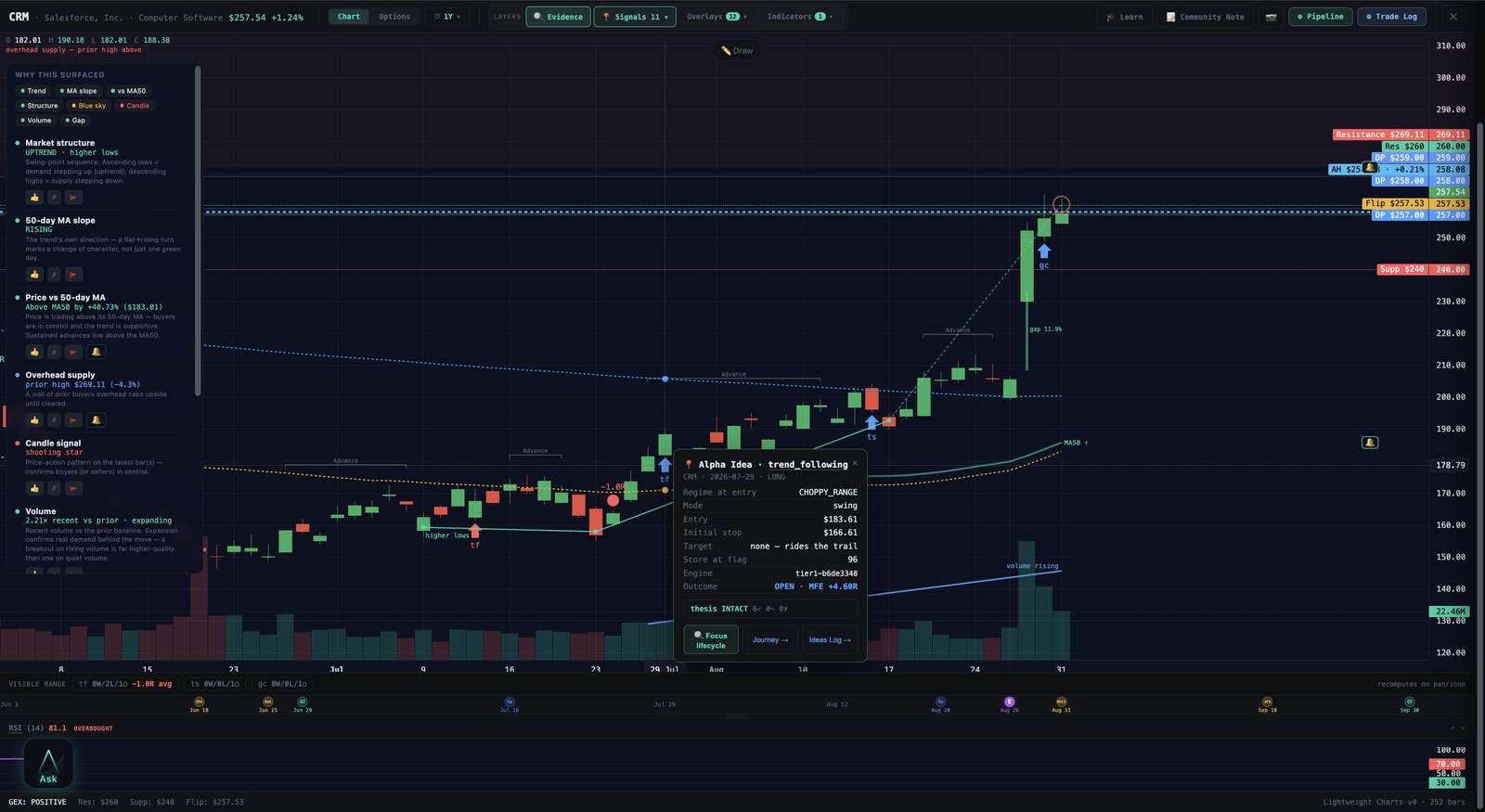
The chart carries the idea's pin, its entry, stop and target, the prior high that caps it, and a "Why this surfaced" panel that states each structural signal in plain English. Agree or disagree with a click; the engine learns from it.

  • Market structure, 50-day slope, price vs MA, overhead supply, candle signal, volume expansion.
  • Signals, overlays and indicators are layers you can switch on and off. Learn opens the lesson for that chart.
  • Community notes, Pipeline and Trade Log are one click away from the pin.
#research/ideas-log/sip:CRM/chart:CRM
A CRM chart with the Evidence layer: a Why This Surfaced panel listing market structure, 50-day MA slope, price vs MA, overhead supply, candle signal and volume, plus an Alpha Idea pin showing entry, stop, score and outcome.

Trade Journey

One chart, the whole trade.

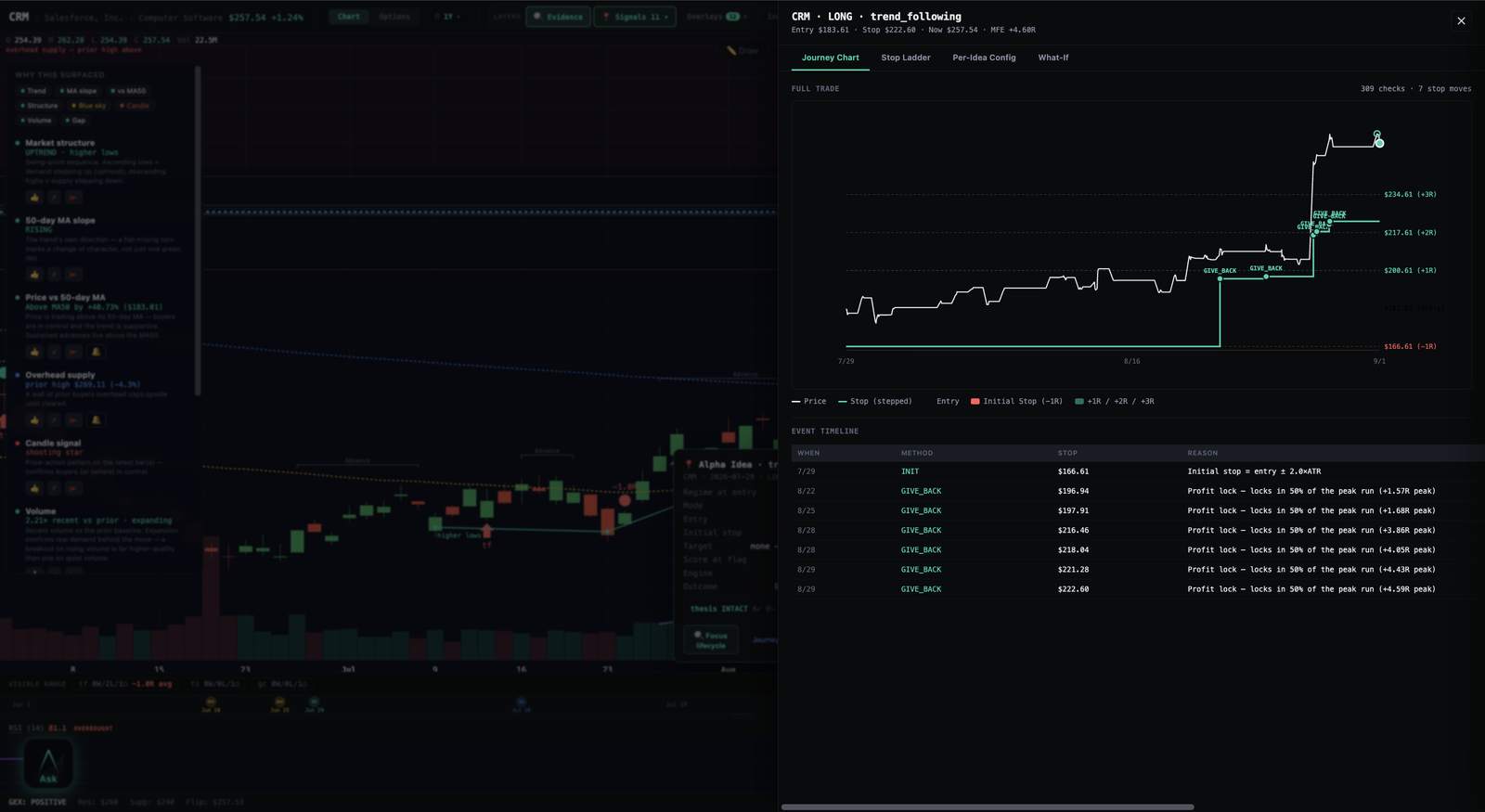
Idea, pipeline, every fill, every stop raise and the exit, numbered and joined in time order. The event timeline names the method and the reason for each stop move, so you can see exactly how a +4.6R run was protected.

  • Stepped stop drawn against price, with the −1R, +1R, +2R and +3R lines.
  • Stop ladder, per-idea config and a what-if tab for a different stop geometry.
  • 309 checks · 7 stop moves · profit lock at 50% of the peak run
#…/chart:CRM · Journey Chart
Trade Journey for CRM long: price with a stepped stop, R levels, and an event timeline of INIT and GIVE_BACK stop moves with their reasons.

VizLab · Edge Cloud

Where your edge actually lives.

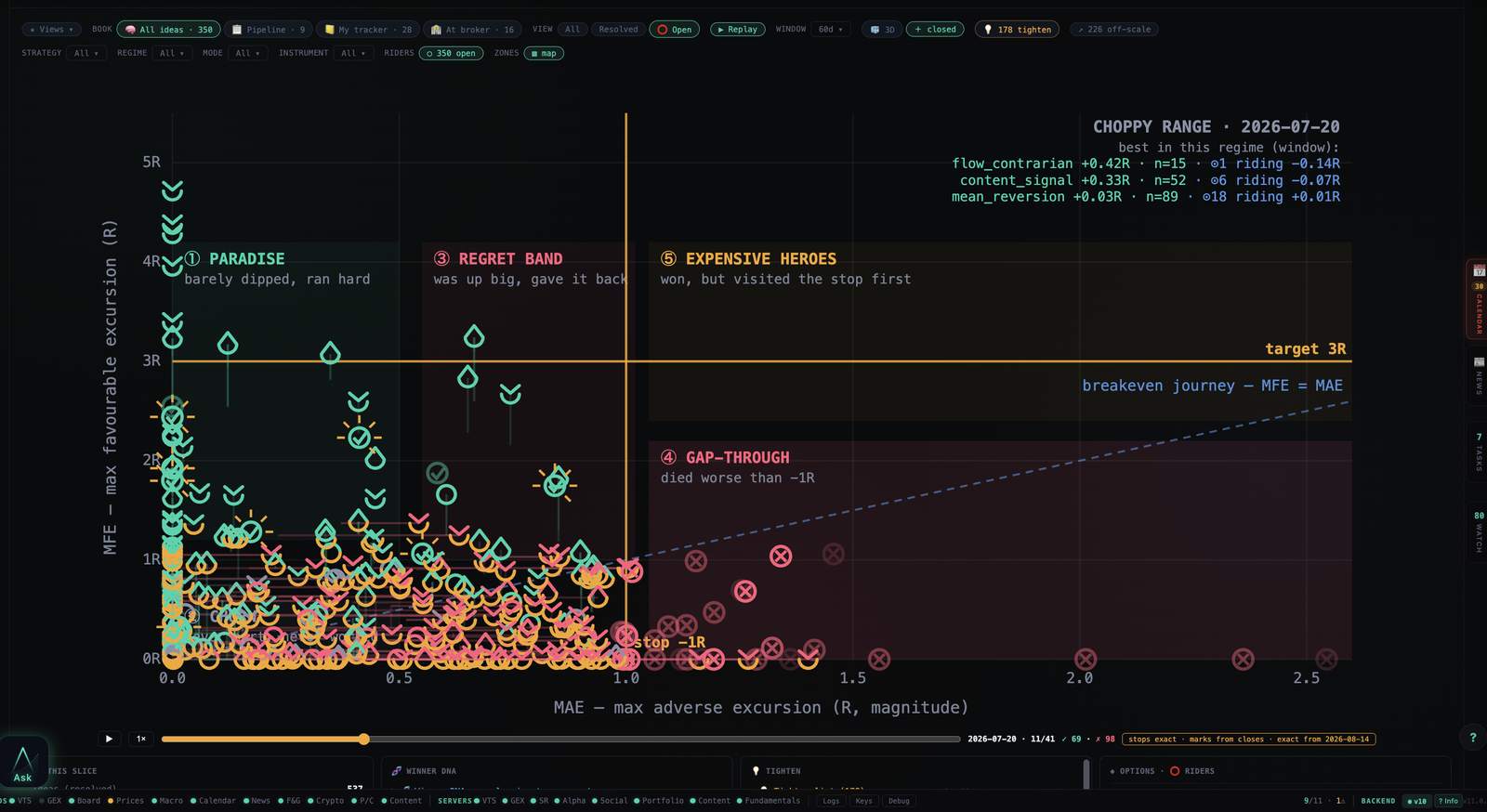
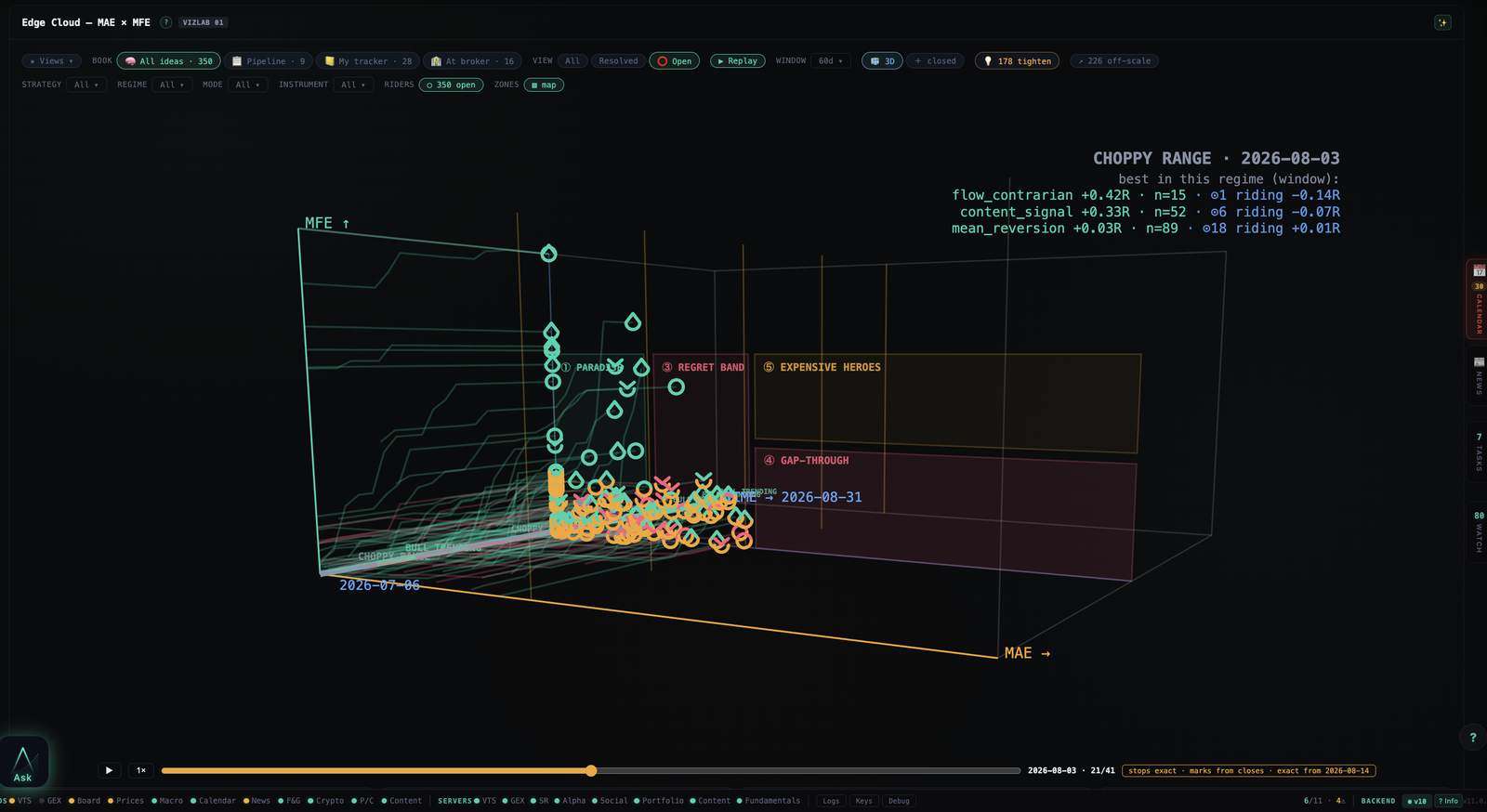
Every resolved idea plotted by how far it went against you (MAE) and how far it ran for you (MFE). The zones have honest names: Paradise, Regret Band, Expensive Heroes, Gap-through. Scrub the replay and watch the cloud form by regime.

  • Best strategies in the current regime, with n and the riders still open.
  • The Journey Cube adds time as a third axis: a rotatable point cloud with a −1R stop wall running through it.
  • Winner DNA: what the winners had in common at entry.
#active-trading · Edge Cloud — MAE × MFE · Replay
Edge Cloud scatter of MAE versus MFE in R for 350 ideas, zoned into Paradise, Regret Band, Expensive Heroes and Gap-through, with a replay slider and the best strategies in a choppy regime.

VizLab · Journey Cube

History you can turn in your hands.

The same cloud with time as depth. Colour is money, depth is when the journey ended, and the regime bands run along the time edge. Press play and the last two months replay in front of you.

  • Auto-rotates, flattens back to 2D, and any point opens a bar-by-bar solo replay of that idea.
  • Drawn on a plain canvas: no plugins, fast on a laptop.
#active-trading · Edge Cloud · 3D
The Journey Cube: a rotated three-axis view of MAE, MFE and time with regime bands and a replay scrubber.

Research · Rotation Graph

Rotation, with a 90-day replay.

A Bloomberg-style Relative Rotation Graph for 11 sectors and 137 industries. Winners, Waking up, Slowing, Losers. Click a sector to drill into its industries. Play the last 90 days at up to 4×.

  • JdK RS-Ratio × RS-Momentum, normalised to SPY = 100.
  • Rotation feeds the idea score and the Momentum Wall.
#research/rotation-graph
Relative Rotation Graph with Technology alone in the Winners quadrant and ten sectors trailing through Losers, with a 90-day replay control.

Research · Themes

Themes with live constituents.

116 investment themes, each with an index, its constituents' price, GEX regime, alpha and RSI, a heatmap, and an AI read of why the theme is moving today. Send the whole theme to a watchlist, the pipeline or the Risk Desk in one click.

#research/investment-themes
Investment Themes: Cybersecurity theme index 1031.4 up 3.14% with eight constituents, GEX regime chips, and an AI analysis rail.

Options Terminal

A chain with a GEX spine.

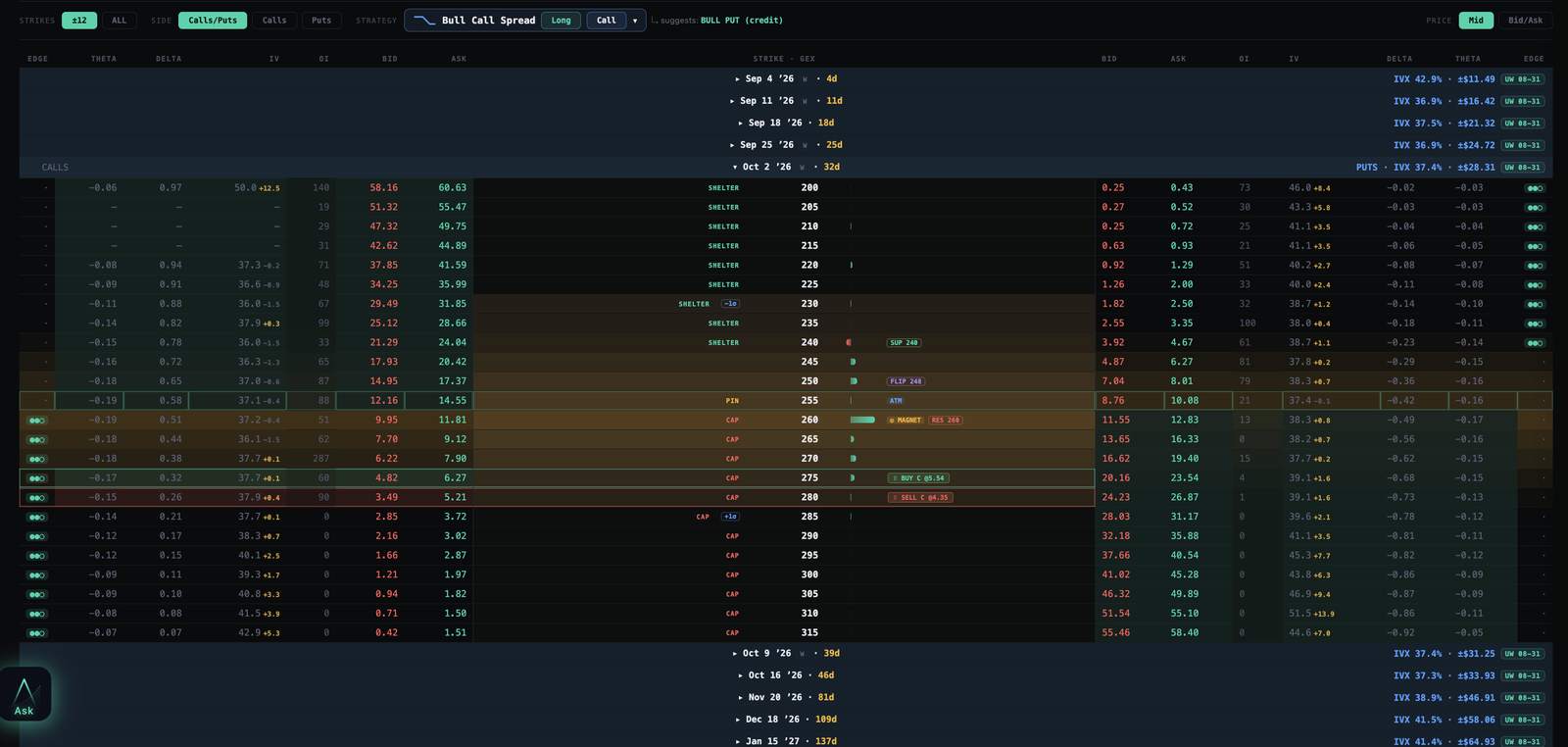
Every strike is labelled by what the dealers are doing there: SHELTER, PIN, MAGNET, CAP. Click a bid to sell or an ask to buy and the structure builds itself, with payoff, probability of profit and Greeks. The ticket is wrapped in a Guardian before it leaves.

  • IV, IV rank, expected move per expiry, and the gamma flip on every chain.
  • Paper by default. Live is capped on the server, per order, per symbol and per day.
#…/sip:CRM · Options
The Options Terminal chain for CRM with SHELTER, PIN, MAGNET and CAP GEX labels on strikes, a bull call spread being built, and IV per expiry.

Regime

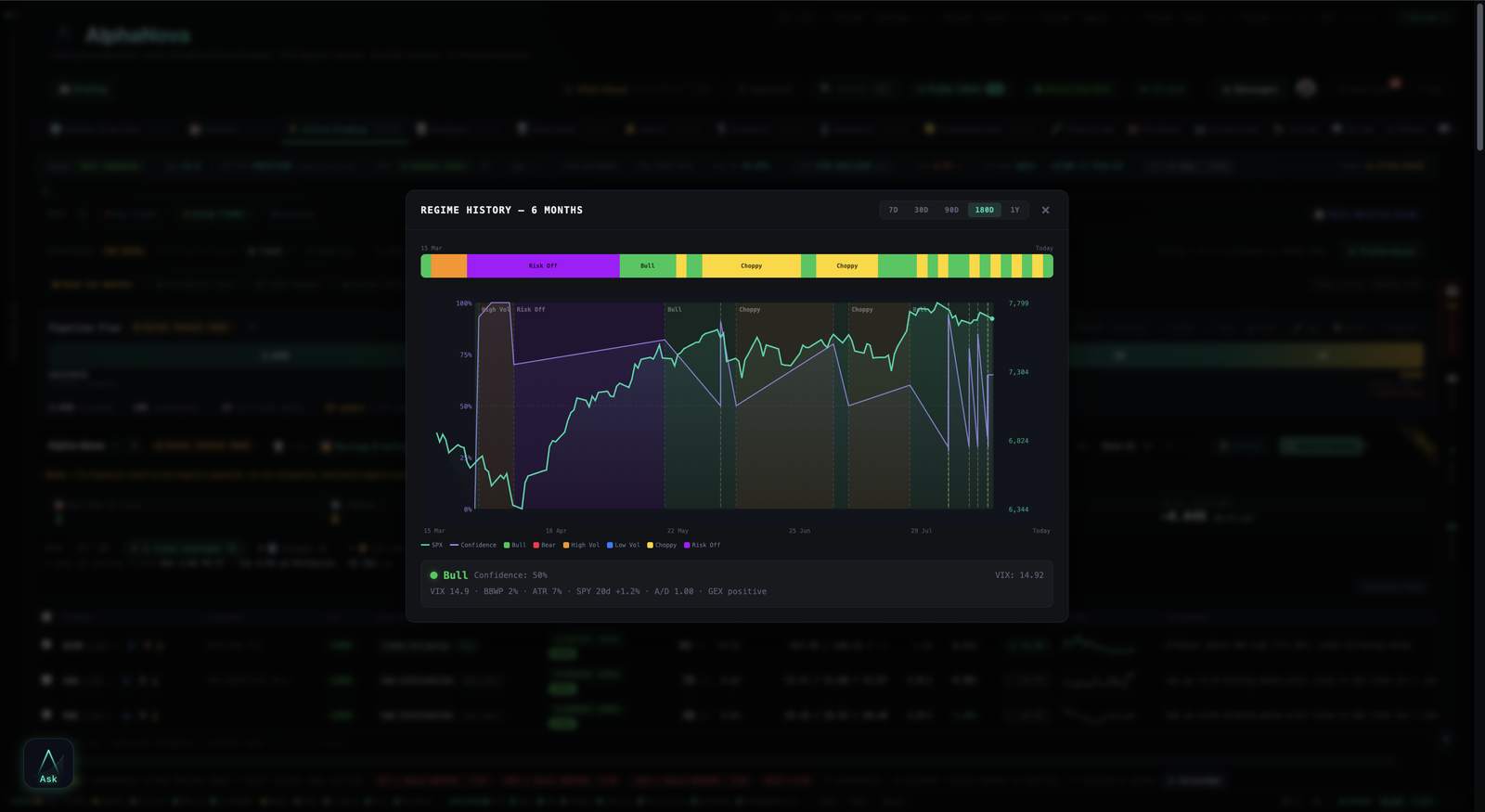
Six regimes, and the history to prove it.

Bull Trending, Bear Trending, High Volatility, Low-Vol Grind, Choppy Range, Risk-Off Crisis. A whipsaw buffer stops the label flickering. The history view shows every regime against SPX and the confidence behind each call.

#active-trading · Regime history — 6 months
Regime history over six months: a coloured band of Risk Off, Bull and Choppy regimes over SPX and a confidence line.

Learn by doing

A guide that walks you to the real thing.

AlphaNova was built so family and friends could learn on the real product, not a simulator. A small guide walks you to the panel a goal needs, says one line, and hands the hard questions to the copilot. Learner Mode turns that into a path.

The guide

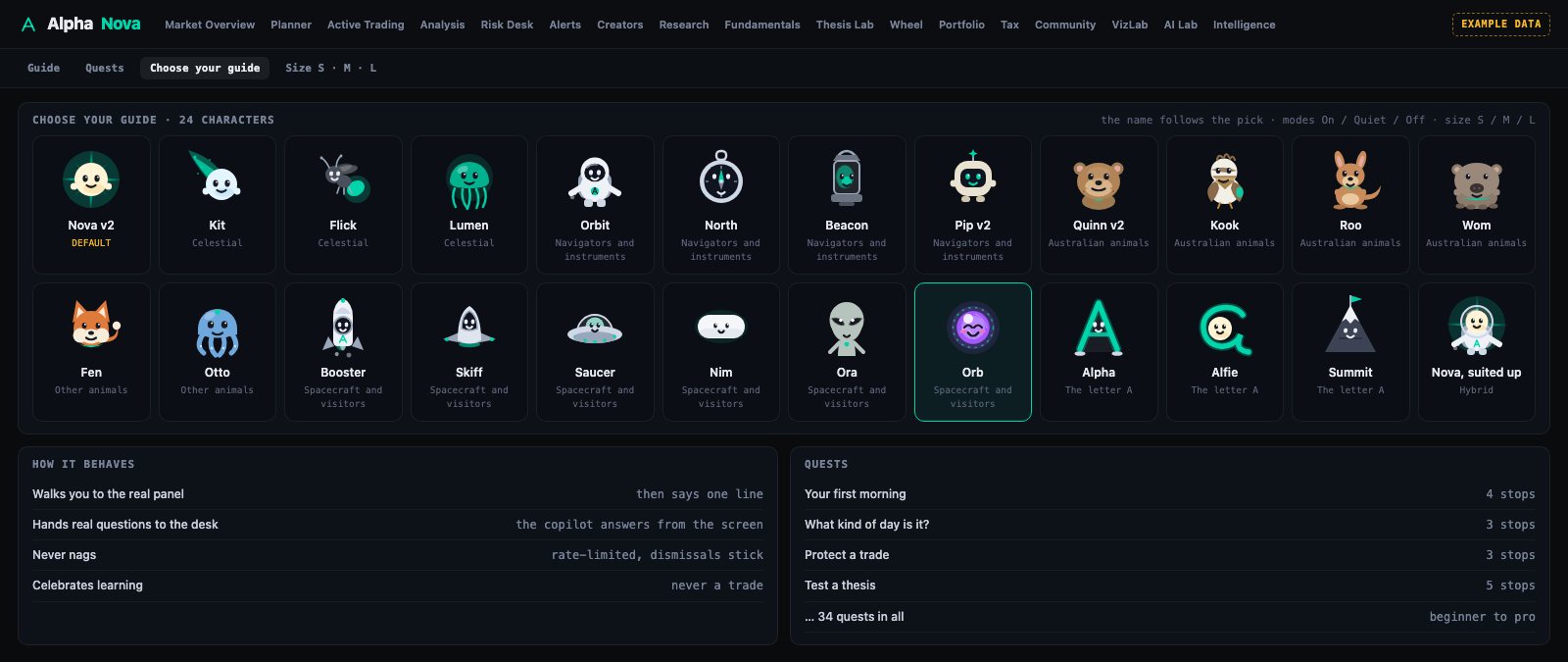
Pick a character. It shows you around.

Twenty-four characters, from a small star to a plasma orb. Yours sits above the Ask button, walks to the right panel, points, and waits while you try it. It notices when you have done it.

  • 34 quests, from Your first morning to Test a thesis, each on the real screens.
  • Show me outlines the exact panel. Ask the desk hands your question to the copilot and asks for a short answer.
  • On, Quiet or Off. It never talks over an order ticket, never nags, and celebrates learning, never a trade.
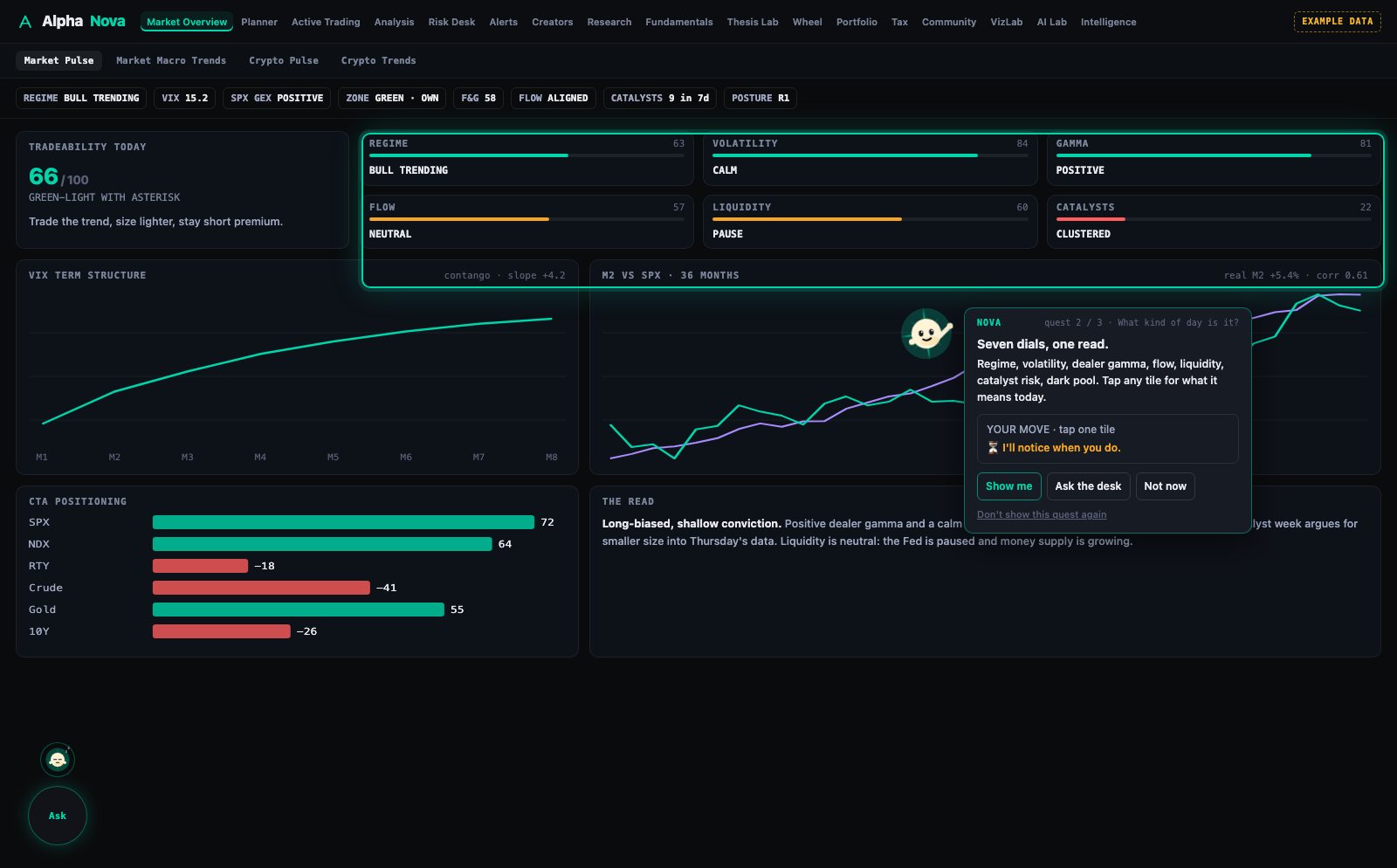
#market/pulse · quest 2 / 3
The guide character beside the Market Pulse dimension tiles, with a quest bubble: Seven dials, one read. Your move: tap one tile.
A quest in progress. The guide outlines the tiles and waits for you to tap one. An illustration with example data.

Learner Mode

A path, not a firehose.

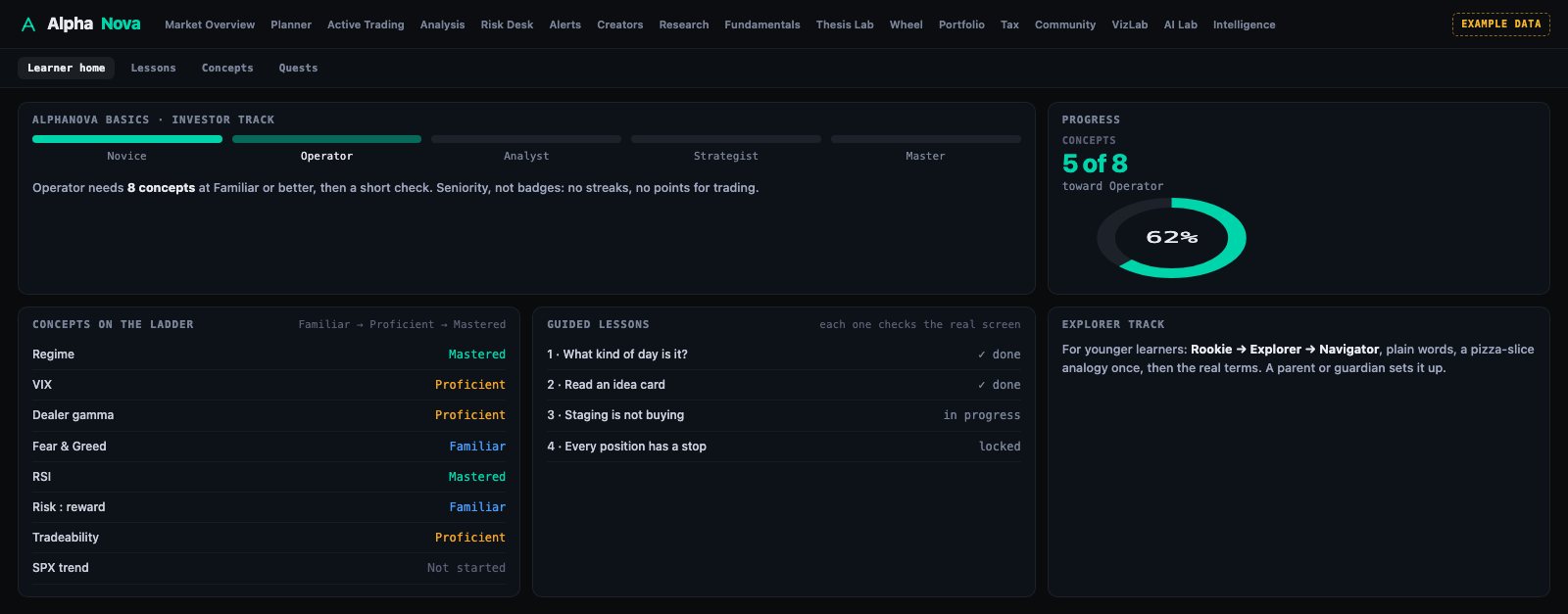
Two tracks. The Investor track climbs trading-desk seniority: Novice, Operator, Analyst, Strategist, Master. The Explorer track, for younger learners, goes Rookie, Explorer, Navigator. Each tier is earned by the concepts you have actually used, then a short check.

  • Seven guided lessons, each one checking the real screen rather than a quiz.
  • Every concept moves from Familiar → Proficient → Mastered as you view it, ask about it and pass its check.
  • No streaks and no points for trading. Progress is what you understand.
#learn · Investor track
Learner home: the investor tier ladder from Novice to Master, a progress ring toward Operator, concepts with their mastery state, and the guided lessons.
Learner home. The tier ladder, concept progress and the guided lessons. An illustration with example data.
Element education

151 terms, three levels

Every term with a dotted underline opens a plain answer, then more detail, then a deep dive. Explain this asks the copilot about the live value on your screen.

Help Center

74 articles and a living FAQ

Plain-English articles for every workspace. A question the articles don't cover gets an AI answer grounded in them.

Read this chart

Eight cards, in order

Any chart, read the way a trader reads it: trend, the 50-day line, the dealer walls, volume, then the plan, with the common misreads named.

Tour and How It Works

28 steps, then the machine

A guided tour across every workspace, and a tab that explains the whole machine feed by feed and panel by panel.

#guide · choose your guide
The guide picker: 24 characters in two rows, from Nova v2 (the default) to Orb, with how the guide behaves and a sample of the quests.
Choose your guide. Twenty-four characters; the name follows the pick. An illustration with example data.

Built to teach

Every panel explains itself. The copilot answers from the screen.

It was built for friends and family first, so nothing assumes you already know. Any number can be asked "what is this?", every chart has a lesson, and the AI copilot reads the live data in front of you rather than talking in general.

Element education · three levelsTry it: click a dashed term
Regime is BULL TRENDING at 42% confidence, VIX is 14.9 and in contango, dealer gamma is POSITIVE, and the swing book is sized at 0.5R per idea.
▲ Copilot2.0Alpha · Flow · Learn · Library
CONTEXTregime BULL·R1gexstructureideasearnings ABLT 09-01rotation+19 more
Why is CRM a bad entry right here?

Four things on your screen say wait. RSI(14) is 81.1 and flagged overbought. The latest bar is a shooting star after an 11.9% gap, so buyers are showing fatigue at the highs. Overhead supply sits 4.3% above at the prior high of $269.11, which caps the reward. And spot is only 3.4% above the gamma flip at $247.64, so a wobble puts you in the zone where dealers amplify moves.

The idea itself is intact: uptrend, higher lows, above the 50-day. The problem is timing, not thesis. A pullback toward the 50-day slope, or a close through $269 on rising volume, is a better entry than this bar.

read from: chart evidence · GEX by strike · Alpha Idea pin (score 96, OPEN, MFE +4.60R) · illustrative answer
education & decision support — not financial advice · the copilot never places or arms orders
  • 71+Help Center articlesFoundations, Features, Fundamentals, Workspaces, Crypto and a living FAQ that grows from real questions. "Reading market conditions like a market maker." "Position sizing: equal risk per idea." "Testing a thesis: claims, evidence and kill criteria."
  • ~140Terms explained in placeA one-line definition, "Tell me more", then a deep dive. "✨ Explain this" sends the live value to the copilot.
  • everyChart has a "Read this chart" lessonA numbered walkthrough in reading order, including the mistakes beginners make on that exact chart.
  • 5Learner Mode ladderWatch → mirror → independent. Unlock by competence, not tenure. No streaks, no leaderboards, no badges for showing up.
    NOVICE→OPERATOR→ANALYST→STRATEGIST→MASTER
  • 28Guided tour steps across every workspaceStarts automatically the first time. Skip it, or come back to it from the banner.
  • ritualsThe Practice PlannerDay, week, quarter and year rhythms for the swing book, the investor book and the wheel, anchored to real dates and prepped with live data. What you actually reviewed is tracked, and a review you silently skipped isn't counted.
  • 1 tabHow It WorksA whole workspace that explains the machine: the feeds, the universe, the pulse anatomy, the regime × strategy matrix, the evidence layer, and "what AlphaNova is, and what it isn't."
app.alphanovainvest.com/#active-trading · Copilot 2.0 docked
The Copilot docked beside Active Trading, with context chips, tools such as Scan setups, Interrogate, Red Team and What-if, and a Three-engine longs play listing CRM, TEAM, ELF and VEEV with their agreement across structure, GEX, rotation and earnings.
Copilot 2.0. Context chips show exactly what it can see. Tools: Scan setups · Interrogate · Red Team · Edge read · Disagreements · What-if · Thesis risk. Plays: Three-engine longs · Rotation leaders I'm missing · Ideas at a gamma wall · Earnings gauntlet · Stops audit.

The AI inside

AI reads. The engine scores. You decide.

The Alpha Engine's scans and gates are rules and statistics over market data. AI widens what it can read (videos, earnings calls, filings, news), writes the explanations, and argues the other side before an idea reaches you. It never places an order.

It teaches

A copilot that reads your screen

  • Context chips show exactly what it can see: regime, gamma, structure, ideas, earnings, rotation.
  • Tools for the hard questions: Scan setups · Interrogate · Red Team · Edge read · Disagreements · What-if · Thesis risk
  • Explain this on any term, with the live value.
  • Help answers grounded in the articles, and every quest and lesson can hand a question to it.
It finds and tests ideas

Reading what the engine can't

  • Creator videos read and every call extracted, in their words.
  • News and economic events classified; the morning read and the Market Pulse narrative written from the day's data.
  • A twelve-section AI thesis for any ticker.
  • Thesis Lab: a thesis broken into testable claims, a skeptic pass against the filings, catalysts checked on the web, and a draft in your own voice.
  • Fundamentals: projections, research reports, call-transcript analysis, filing summaries. AI Lab widgets from plain English.
It checks and protects

Arguing the other side

  • Red-team an order before it goes.
  • The risk advisor and allocator explain the book and the size.
  • The tuner proposes weight changes from resolved outcomes. Nothing applies without a person approving it.
  • Price rules such as close below 150 are checked by code with the live price, never by the AI.
What the AI never does
  • Place, arm or change an order.
  • Set a thesis verdict. The skeptic can argue; the verdict is capped in code.
  • Decide a price rule or a stop.
  • Change the engine on its own.
  • Give personal financial advice.
Which models

The right model for each job

Anthropic's Claude by default: a fast model for high-volume reading and a deeper one for research. Members can bring their own OpenAI or xAI Grok key. Every job has a named role and a model tier in one registry, and the cost of every call is metered and shown. Earnings-call audio is transcribed on our own server.

Creators

Finance creators, audited.

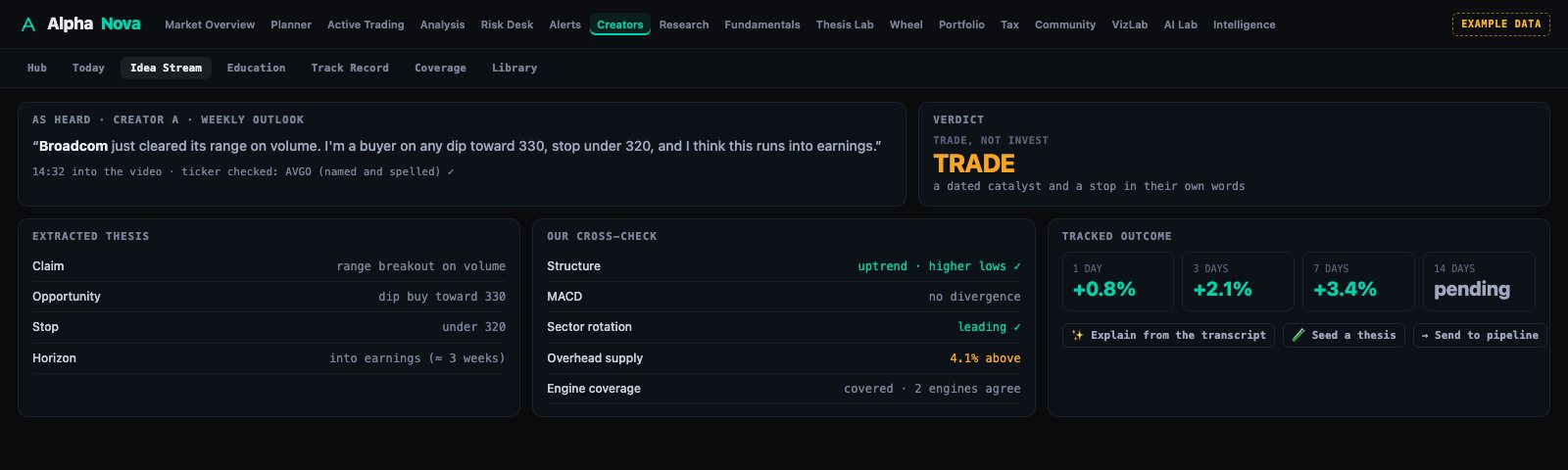
Finance video is full of confident calls. AlphaNova reads them, writes down exactly what was said, checks it, and keeps score.

From a video to a track record

Every call, in their words, marked to market.

  1. Discover. New videos from followed creators, checked every 15 minutes.
  2. Read. AI extracts every directional call in the creator's own words, with the moment it was said.
  3. Check. The company named and the ticker spelled must agree, so a misheard name never becomes the wrong stock.
  4. Track. Each call is followed at 1, 3, 7 and 14 days.
  5. Score. Every creator earns a 0–100 credibility score from those outcomes.
  • Promotional segments are quarantined, not scored.
  • Calls on futures or currencies we can't price are flagged, with an AI research note on what it would take.
  • One click turns a creator's idea into a thesis, where their claims are leads to test, never facts. Ideas reach your pipeline only when you send them.
#creators · idea stream
A creator idea drill-down: the call as heard with a timestamp, a trade-not-invest verdict, the extracted thesis, our cross-check and the tracked outcome at 1, 3, 7 and 14 days.
Idea drill-down. The claim as heard, a trade-or-invest verdict, our cross-check and the tracked outcome. An illustration with example data.
Portals

One page per creator

Today, Idea Stream, Education, Track Record and Coverage, with a profile of their style and strengths built from what they publish.

Content library

Everything they've said

Full history that never ages out, searchable across titles, transcripts and tickers.

Consensus

Where they agree

A consensus strip and a themes board show where creators line up, where one stands alone, and which tickers they keep coming back to.

Education

The lessons, kept

Teaching segments are filed as lessons, separate from the calls, so the good explanations are easy to find again.

Community

Share calls, not screenshots.

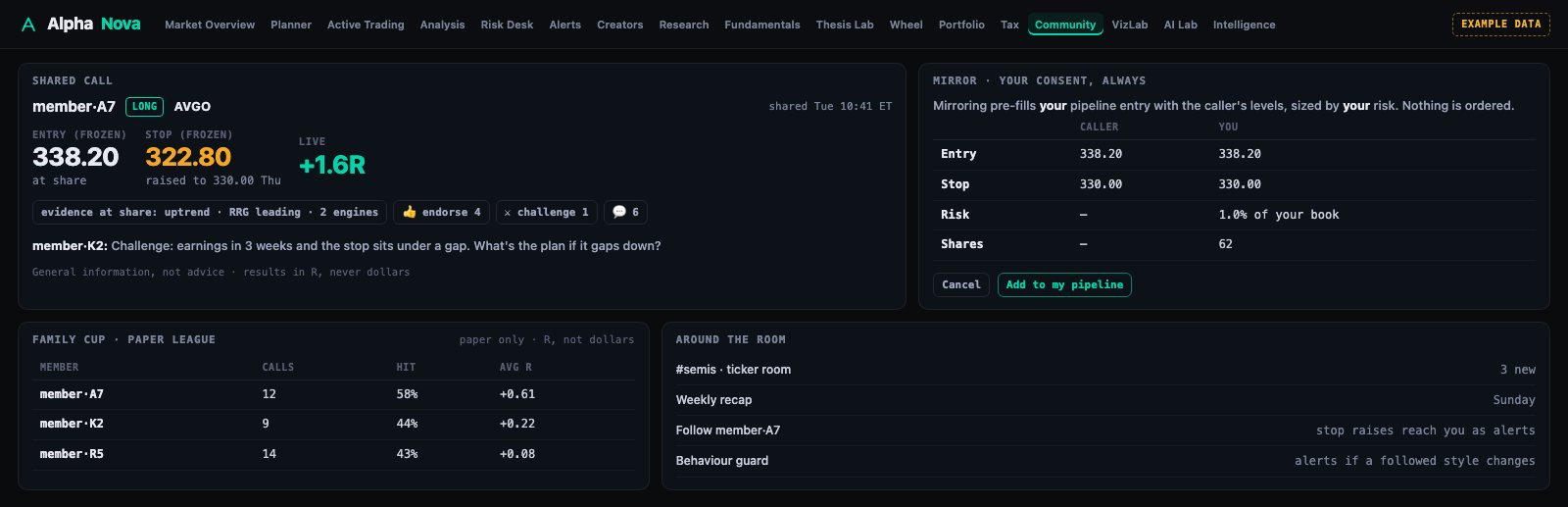
A small, private room for members. Every shared call is a living record: its entry and stop are frozen when it's shared, results are counted in R, and nothing copies a trade for anyone.

How it works

Calls that keep their receipts.

  • The entry, the stop and the evidence behind a call are frozen when it's shared. Stop raises reach followers, and the result is live R.
  • Endorse or challenge, with threads. A challenge is a feature, not a fight.
  • Share any chart or VizLab graph. Topics, ticker rooms and a weekly recap.
  • Follow a member: their stop raises and closes reach you as alerts, and a behaviour guard tells you if their style changes.
  • Mirror, with consent. It pre-fills your own pipeline entry with their levels, sized by your risk, and stops at your confirm. Nothing is ordered.
  • The Family Cup, a paper league scored in R. Presence and one-to-one messages.
#community
A shared call card with the entry and stop frozen at share, a stop raise, live R, endorse and challenge counts and a challenge in the thread, beside the mirror consent panel and the Family Cup paper league.
A shared call and the mirror consent. Frozen levels, live R, and your own sizing before anything reaches your pipeline. An illustration with example data.
What it will never do

No copy trading, no fees for followers, no dollar leaderboards, no streaks, and nothing public. It is a room for invited members, and every card says it is general information, not advice.

De-risked by design

Stops that survive your laptop closing.

The first live order taught us that a stop placed by a browser is not a stop. Protection now lives on the server: it arms when the fill lands, it survives restarts, and it re-arms if it vanishes while you still hold the position.

  • 01Server-side protection, armed on fillA trailing stop ladder is attached the moment the broker reports a fill, with no tab open. A poller replays fills missed while the service was down. One ladder per entry, never more stop than position.
  • 02Drag the stop, the broker order movesTightening applies at once. Loosening asks you to confirm. Off-hours, the move is queued, retried every minute, and you get an email when it lands or why it didn't.
  • 03The Options GuardianProfit target rests at the broker; the risk side is watched on the server. Spreads are guarded as a structure, never leg by leg.
  • 04Paper and live, side by side, never confusedSeparate keys, separate orders, separate protection. Live is admin-only, capped per order, per symbol and per day on the server, and every ticket says which account it targets.
  • 05Governors on the bookConcentration, FX exposure and cash versus policy, with a tax-aware trim advisor wired to the Australian CGT engine.
  • 06Nothing trades your real money on its ownThe copilot never places or arms orders. The tuner proposes and a human approves. Unattended experiments run on paper, and the paper cohort is read before anything is allowed to flip.
Confirm · SHORT PUT 130 · 2× NOW 2026-10-02
LegsSELL 130P @2.34
Netcredit 2.34
AccountAlpaca PAPER · Options BP $76,747
Max profit / loss$234 / −$12,766 · BE $127.66 · POP 80%
Caps & levelorder $468 ≤ $500/order · $2,000 total premium cap · 10 contracts/order · 5 orders/day — server-enforced
Guardian plannone auto-arms (short single — arm manually from the tracker)
Provenancewheel_csp · book W
Est. fees$1.04 · OCC-guarded ×100 math ✓
🛡 Red Team this order 💬 Explain this structure ⚡ Submit — arms Guardian on fill

The real ticket, rebuilt in HTML for this page. Every field is a live check, and the caps line is what the server will enforce.

Options income · The Wheel

The wheel, with the rules written down.

The wheel is the oldest routine in options income. Sell a cash-secured put on a stock you would be glad to own. If it is assigned, take the shares and sell covered calls above what they cost you. When the shares are called away, start again. It is simple to describe and easy to do badly: puts sold on stocks nobody wanted to own, rolls that pay to stay in, calls sold under cost. The Wheel desk turns each of those mistakes into a rule.

One cycle, five steps

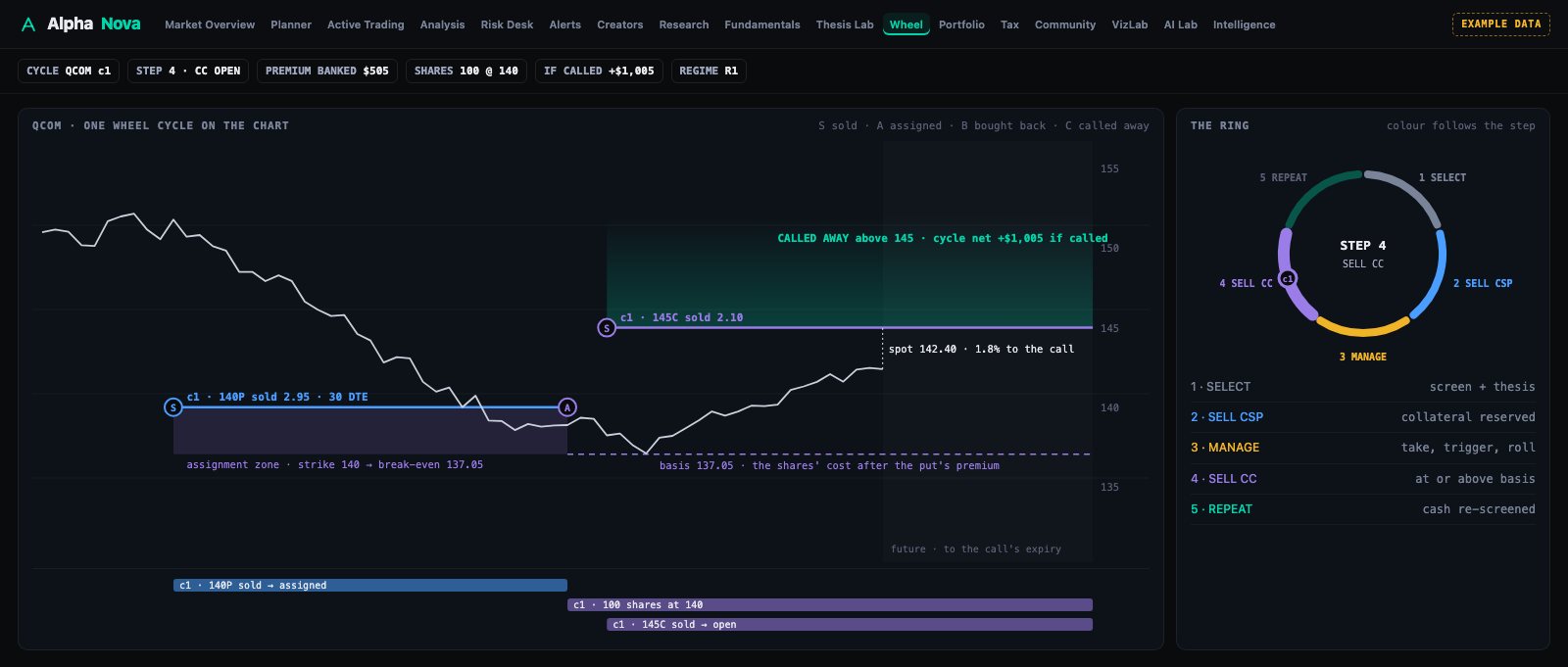
The whole cycle, drawn as one object.

  1. Select. Ten gates per name, starting with a thesis you have written down. Every fail says why.
  2. Sell the put. Delta 0.20 to 0.30, 21 to 45 days out, open interest of at least 500. The full assignment cash is set aside the moment it sells.
  3. Manage. Take the profit at 50%. A card when delta doubles or the strike is tested. A roll is offered only for a net credit, and after two the cards offer the assignment instead.
  4. Sell the call. At or above what the shares cost you. A call below basis is never offered inside the wheel; it exists only as an explicit exit.
  5. Repeat. Freed cash goes back through the screener, never through loyalty: the name re-qualifies on today's gates or the money goes to the next candidate.
  • On the chart a cycle is one object: the put's strike and its assignment zone, the basis line, the call and the called-away zone, with a marker at every fill. S sold · B bought back · A assigned · C called away
  • These are the house defaults. Nine of them can be tuned in your own parameter book, inside limits the server sets.
#wheel · chart layer
One wheel cycle on a price chart: a sold 140 put with its assignment zone, the assignment, the shares' basis line, a sold 145 call with the called-away zone above it, and the desk's five-step ring pinned on step 4, Sell CC.
One cycle on the chart. The put, the assignment, the basis and the covered call, coloured by step, beside the desk's five-step ring. An illustration with example data.

The screener

Ten gates before a put is sold.

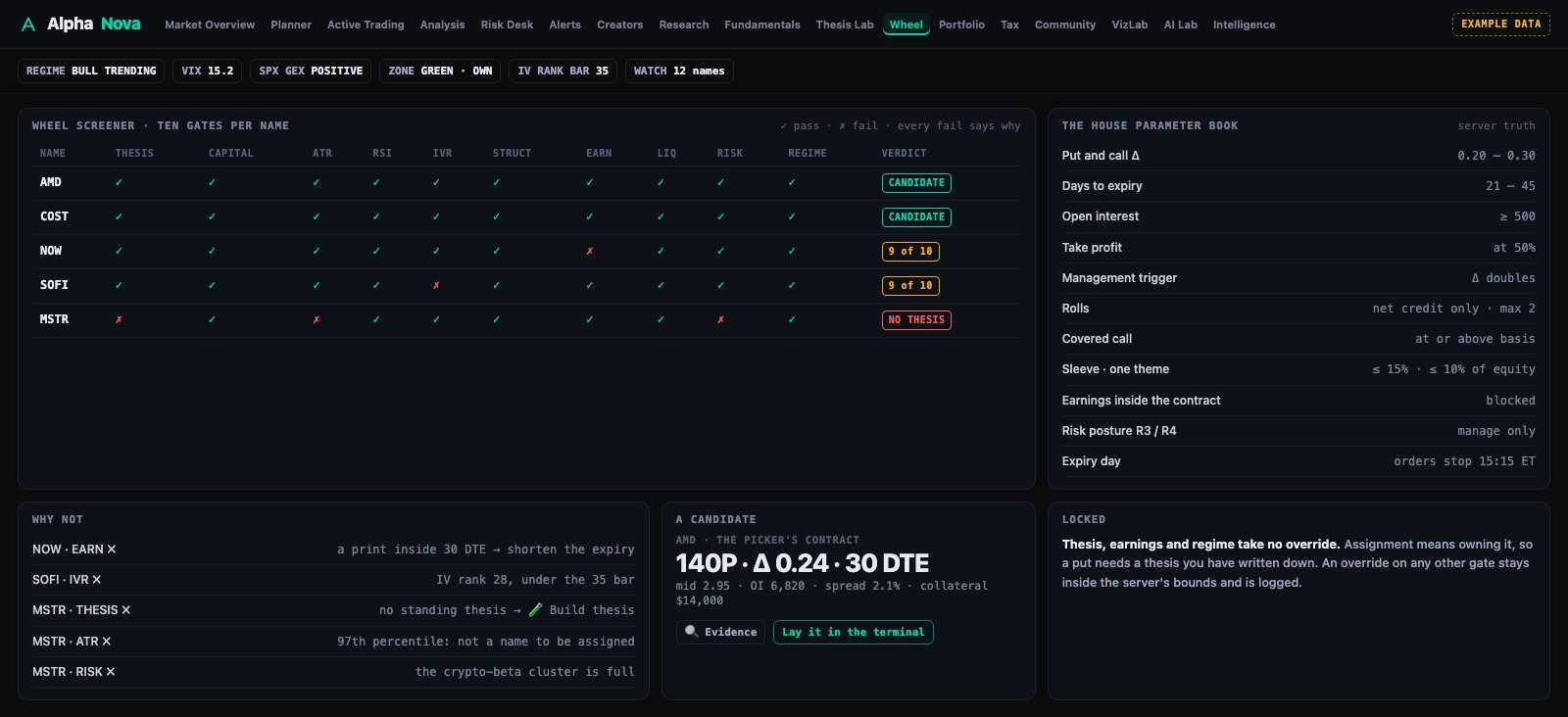
Thesis, capital, ATR, RSI, IV rank, structure, earnings, liquidity, risk and regime. Each gate shows its number, its bar and the reason the rule exists, and the picker names the exact contract a passing name would sell.

  • The thesis gate comes first. Assignment means owning the stock, so a put needs a thesis you have written down and still believe. No thesis, no put, and the button to build one sits on the card.
  • IV rank of at least 35. Below it you carry the assignment risk for a premium that doesn't pay for it.
  • No earnings print inside the contract's life, and no new puts when the risk posture reads R3 or R4. Open wheels are still managed.
  • By default the income sleeve is capped at 15% of equity, and correlated names (crypto-beta, AI semis) share one cap of 10%.
  • Thesis, earnings and regime take no override, and capital is arithmetic. Any other override needs a written reason, stays inside the server's bounds, expires, and is audited.
#wheel · screener
The wheel screener: five names against ten gates, two candidates, two names failing one gate each and one rejected for having no thesis, with the reason for every fail, the picker's contract for a candidate and the house parameter book.
The screener. Ten gates per name, the reason for every fail, and the house parameter book beside it. An illustration with example data.
The wheel, honestly

Income on stocks you want to own, not a way to make a bad stock pay

  • A cash-secured put carries almost all of the stock's downside for a capped premium. If the stock halves, you own it at the strike.
  • The premium is the most a leg can make. The payoff chart never draws a floor under the loss, and its left edge says so.
  • There is no stop order on a short put. Assignment is the plan, and a broken thesis is the exit.
What the wheel desk will never do
  • Offer a covered call below your cost basis inside the wheel.
  • Offer a roll for a debit.
  • Offer a new put on a name with no thesis, across an earnings print, or into an R3 or R4 risk posture.
  • Send an order you didn't decide. The copilot can explain a card; it can't choose one.
  • Count simulated practice as a result.

Running the wheel

Decided overnight in Melbourne. Re-checked at the New York open.

A wheel needs attention at awkward hours. The desk watches every leg against the house rules and puts a decision in front of you, priced, when one is due. You choose, write down why, and the order goes now or waits for the open inside a limit you set.

Position now · decision cards

When something is due, a card says so.

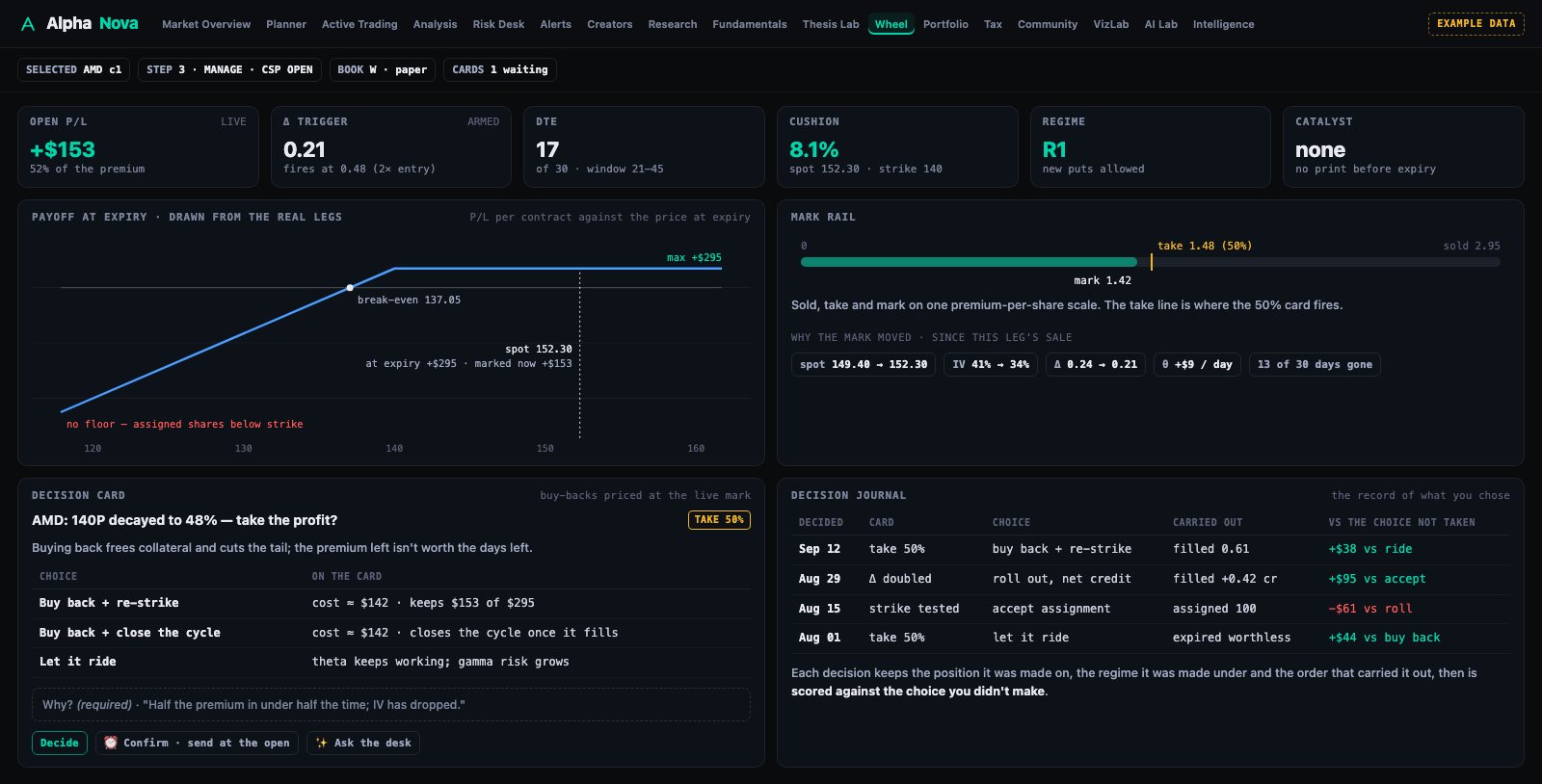
The selected wheel shows six live tiles (open P/L, the delta trigger, days left, cushion, regime and catalyst), the mark on a rail between what you sold and where the profit is taken, and a payoff drawn from the real legs.

  • Seventeen kinds of card: eleven for each cycle, such as take 50%, strike tested, delta doubled and a stuck wheel, and six for the whole book, such as a full sleeve or too many legs on one expiry. A buy-back on a card is priced at the live mark when there is one.
  • Two cards exist to say the desk can't see: a holding with no known cost basis, and a check that could not run. Neither guesses.
  • A decision needs a reason in your words. The journal keeps it with the position, the regime and the order that carried it out, and scores it against the choice you didn't make.
  • Cards reach you as alerts with the Wheel tab closed.
#wheel · position now
The selected wheel: six live tiles, a payoff at expiry with no floor under the loss, the mark rail with the 50% take, a take-profit decision card with three choices and a required reason, and the decision journal.
Position now. Live tiles, the payoff with its downside drawn, a decision card and the journal. An illustration with example data.

Send at the open

Armed with a limit, sent five minutes after the bell.

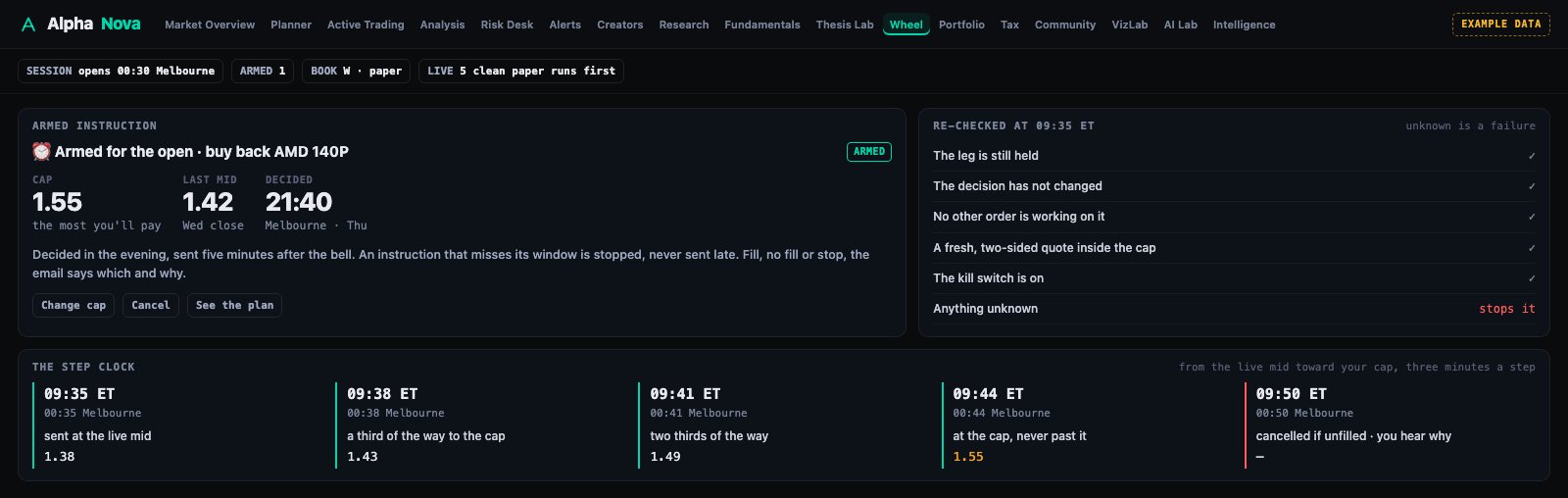
Most wheel decisions are made in the evening in Melbourne, with New York shut. An option order sent then waits for the open at a price set the night before. Instead you arm it with a limit (the most you'll pay to buy back, or the least you'll take to sell), and at 09:35 ET the server re-checks it and sends it at the live mid.

  • It steps toward your limit at 09:38, 09:41 and 09:44, never past it, and cancels at 09:50 if it hasn't filled.
  • Re-checked at the open: the leg is still held, the decision hasn't changed, no other order is working, and the quote is fresh and inside the limit. Anything unknown stops it.
  • An instruction that misses its window is stopped, never sent late. Filled, unfilled or stopped, an email says which and why.
  • A live account stays closed to it until five clean paper runs, with every closed gate named.
#wheel · armed for the open
A buy-back armed for the open: its cap, the checks run at 09:35 ET, and the step clock from the live mid at 09:35 to the cap at 09:44 and a cancel at 09:50, in New York and Melbourne time.
Armed for the open. The cap, the checks at 09:35 ET and the step clock in both time zones. An illustration with example data.
Governance

Shadow, then paper, then live

The wheel book starts with simulated fills, moves to paper, and only then to a live account. Its first verdict waits for 30 closed cycles, read on a measure fixed before the first one. Simulated cycles never count.

The honest comparison

Against simply holding the shares

When the prices it needs are on record, a closed cycle is compared with buying and holding the stock over the same days, and says if holding would have done better. When they aren't, it shows a dash, not a guess.

Strategy books

Cash that is really there

Every wheel order is stamped to its own book at the broker. Assignment cash is reserved when the put sells, so two puts can never pass on the same dollar, and the books sum to the account.

Australian tax

Written options, computed

Premiums, buy-backs, expiries and assignments, worked through under Australian CGT rules: an assigned put's premium comes off the shares' cost base, and called-away shares get the 50% discount only after twelve months. Paper and simulated cycles are never taxed.

Learn it first

From the first put to the Friday desk

A plain-English Help article, a two-lesson Copilot path, a guide quest that walks you through screening, and a weekly Friday expiry desk in the Planner.

Creators who sell options

Positions, not calls

When a finance creator talks about the puts they have sold, the ledger records positions and marks them at our prices. Following one is a separate, flagged lane: paper only, with its own small caps.

An honest scorecard

If the numbers say it doesn't work, the screen says so.

Most tools sell you the winners. AlphaNova tracks every idea to its outcome and reports it, including the experiments that failed. A fake number is worse than no number.

Options paper cohort · Sep 2026

The first options cohort failed. We said so.

The same ideas taken as shares won. The options selector bought them a median 28 days late, with +1.28R already gone, and a −50% premium stop fired while the idea was still intact. Verdict: do not flip to live. The next arm was pre-registered before it ran.

21%options hit rate, n=33
73%same ideas as shares
−0.46Rpremium-R
+0.74Rshare-side control
Liquidity · BTC vs global M2

−0.78, not the +0.83 everyone reposts.

The chart that says Bitcoin follows global money supply with a 12-week lag is everywhere. Our live series, with China's stale data excluded and the 2025–26 institutional decoupling in, shows the opposite sign. It is printed on the panel next to the meme number.

−0.78live correlation
+0.83the reposted figure
Data quality

UNKNOWN is a value.

An off-hours mark renders UNKNOWN, never $0. A dead feed shows as degraded and lowers confidence; it never fakes a neutral-looking 0.85 put/call. An instrument we can't price is flagged uncovered and never scored.

—never a silent default
degradedis shown, not hidden
Alpha Ideas

BETAFit is not win probability.

Alpha Ideas carry a beta label in the app: "Fit measures match the engine's playbook, not win probability; calibration against real outcomes is in progress. Treat as research input, not signal." That label stays until the calibration earns its removal.

2,658ideas tracked since Apr 2026
in-appaudited scorecard
Swing book · validation

The edge, right-sized.

The headline +0.27R per idea was in-sample. Out of sample it is about +0.18R, with a bootstrap floor still above zero. Without the regime gate the book falls to roughly zero, so the gate is the edge. Median worst drawdown is stated, not hidden.

+0.18Rout-of-sample
−12.7Rmedian worst drawdown
Intraday strategies

Three strategies killed by evidence.

Gap-fade, gap-continuation and intraday mean-reversion were tested at one-minute resolution, in and out of sample. Mean-reversion lost on all 15 symbols. They are not in the product, and the reason is written down.

0 / 15symbols where mean-reversion paid
writtendown, in the app

VizLab

Ten instruments for seeing the market's structure.

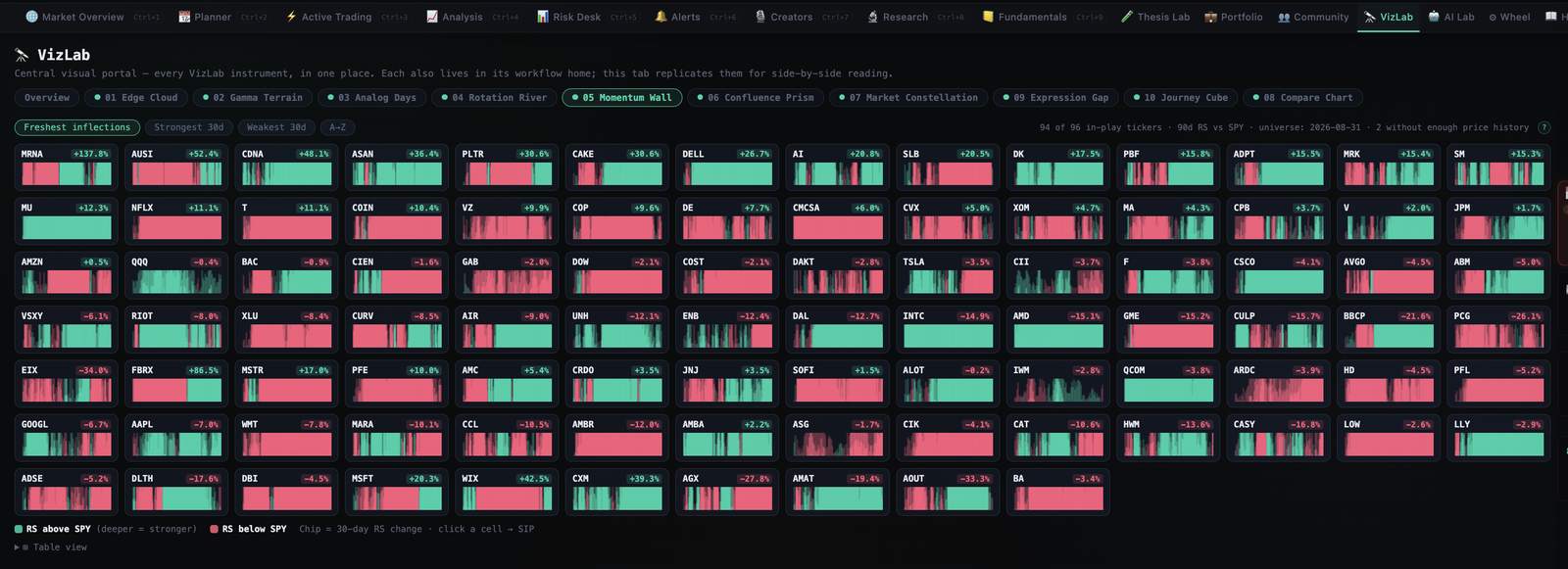
Each visual lives in its workflow home. VizLab puts them side by side for reading, comparing and teaching. Select an instrument to see it.

#vizlab/momentum-wall
The Momentum Wall: 94 tickers as barcode strips of 90-day relative strength versus SPY, teal above and red below, with 30-day change chips.
05 Momentum Wall. 94 of 96 in-play tickers as 90-day RS barcodes versus SPY. Deeper teal is stronger. Click a cell for the Stock Intelligence Panel.
01 EDGE CLOUDMAE × MFE of every resolved idea, zoned and replayable.
02 GAMMA TERRAINDealer gamma by strike and expiry as a landscape.
03 ANALOG DAYSThe days in history that looked most like today, and what happened next.
04 ROTATION RIVERSector leadership flowing through time.
05 MOMENTUM WALLRelative strength barcodes for the whole in-play universe.
06 CONFLUENCE PRISMHow many independent engines agree on each idea.
07 MARKET CONSTELLATIONThe universe clustered by behaviour, not sector.
08 COMPARE CHARTAny instruments on one normalised chart.
09 EXPRESSION GAPWhere the shares and the options on the same idea disagree.
10 JOURNEY CUBEMAE × MFE × time, rotatable, with a −1R stop wall.

The whole desk

Nineteen workspaces. Reorder them, hide them, keep the ones you use.

Select any workspace to see an illustration of it, drawn with example data.

🌐Market Overview⌘1Market Pulse, macro trends, crypto pulse, VIX term structure, money supply, CTA positioning.See it ↗
📆PlannerPlaybooks and rituals on real dates: stop checks, Friday expiry desk, quarterly thesis reviews.See it ↗
⚡Active TradingRegime strip, Alpha Ideas, pipeline, tracker, Alpaca paper and live, working orders.See it ↗
📈AnalysisMarket gamma exposure, the GEX board, news sentiment, the SPX trend monitor.See it ↗
📊Risk DeskBook risk, AI advisor, candidates, allocator, posture, governors.See it ↗
🔔AlertsPrice, volume and GEX-regime alerts, armed automatically on every position.See it ↗
🎙CreatorsCreator portals, content library, scored alerts, instrument research.See it ↗
🔬Research26 sub-tabs: rotation, regime, flow, liquidity, dark pool, insider tape, factors, social, earnings, themes.See it ↗
📒FundamentalsSnapshot, financials, earnings, call transcripts, projections, analyst views, SEC filings, screener.See it ↗
🧪Thesis LabWrite a thesis, have it broken into claims you can test, track evidence and kill criteria.See it ↗
🛞WheelCash-secured put to shares to covered call, with live position tiles and a Friday expiry desk.See it ↗
💼PortfolioNet worth across 11 asset types and every broker, allocation, currency exposure, projections, hygiene.See it ↗
🧾TaxAustralian tax centre: FIFO lots, the 50% discount, franking credits, RBA rates, a tax pack.See it ↗
👥CommunityShare calls with entry and stop frozen at the time of sharing. Results in R. No dollar leaderboards.See it ↗
🔭VizLabThe ten visual instruments, side by side.See it ↗
🤖AI LabA widget canvas: impact pulse, ripple map, catalyst calendar, theme radar, composer.See it ↗
🧠IntelligenceThe engine's own scorecard: strategy × regime matrix, source attribution, tuner, cohort diagnostics, audit.See it ↗
📖How It WorksThe machine explained, feed by feed and panel by panel.See it ↗
⚙AdminFeeds, cache, processes, keys, users, compliance and backups, for the person running it.See it ↗
⌘KEverywhereUniversal search opens the Stock Intelligence Panel for any ticker: overview, trading, options, research, social, positioning, AI thesis.See it ↗

Portfolio intelligence

Built in Melbourne for people who trade New York overnight.

The US session opens at 11:30 pm in Melbourne. AlphaNova is written for that reality: the morning briefing reads the overnight close, the planner puts the Friday expiry desk before the cutoff in your time, and the portfolio speaks AUD.

Multi-asset

Eleven asset classes, every account

US and ASX equities, ETFs, options, crypto, property, metals, super, bank accounts, vehicles, collectibles and liabilities, grouped by the account that holds them.

CGT engine

Australian tax, done properly

FIFO lot matching, the 50% discount past twelve months, cost base elements, franking credits, RBA rates locked at acquisition. A tax pack when you need it.

Brokers

Mirror your brokers, import the rest

Alpaca paper and live are wired for execution. Other brokers mirror into the register through a four-step CSV import with column mapping.

Privacy

Hide the numbers when someone's watching

One switch redacts totals or every dollar figure on the tab. Shift+H. Display-only, per browser.

Why it exists

It started as "I need to streamline my workflow." It escalated quickly.

The short version
  1. A software career. Enterprise products, built and sold, for a working lifetime.
  2. A trading education. Options and market structure, learned properly, from people who teach it well.
  3. A ridiculous amount of wasted time finding tools that would let a technologist learn and trade without ten tabs open.
  4. One app. First for one desk, then for friends and family, which is why it teaches.
  5. Six months of shipping. 3,218 commits since March 2026, every feature justified by the edge it adds, every experiment read honestly.

I've been a software guy my whole professional career. I came to trading the way most people do: a course, a broker, a dozen tools that didn't talk to each other, and far too much time lost to trial and error on platforms that were hard to love. I'm a technologist, and it still nearly put me off. A lot of people would have been.

So I built the thing I wanted. One app, one interface, all the hard stuff brought together so the work is seamless and, honestly, fun. Ideation, analysis, trade setup, placing the trade, automating the stops, managing the risk in the book. It surfaces alpha from a lot of places and it shows you why.

I wanted my friends and family to be able to use it, so it is built to teach. Every panel explains itself in plain English. There's a copilot you can interrogate: "why is this a bad entry?", "explain this term structure like I'm five", and it answers from the live data on the screen, not from a textbook.

Nothing here is advice. It's the desk I wish I'd had on day one.

Dave StuartFounder · Melbourne, Australia

Who it was designed for

Four kinds of people, one desk.

Swing & options traders

Trading US markets overnight from AU, NZ, Asia or Europe

The read before the open, ideas with evidence, a chain that shows where the dealers are, and stops that don't depend on anyone being awake.

Investors

Running a family book across brokers, currencies and asset types

Theses that can be tested, quarterly rituals, concentration and FX governors, and a tax engine that knows what a franking credit is.

Learners

Starting properly, without the scavenger hunt

Learner Mode on the real product. Watch, mirror, then go independent. Paper first. Every term explained where it appears.

Educators & academies

Teaching options and market structure

A curriculum on a desk where students can see the live structure being described and ask the copilot to explain it again.

Contact

Private, and not offered to the public.

AlphaNova is used by its builder and a few family and friends. There is no sign-up, no subscription and no demo. If you are interested in a partnership, or in acquiring the company, we would like to hear from you.

Partnership or acquisition

Get in touch

We use your details only to reply. They are not added to any list. Privacy · Terms

Thanks. Dave will reply personally, usually within a week.
What we can talk about

Partnerships and acquisition

  • Brokers, data providers and educators who want to work together
  • Licensing or white-label conversations
  • Acquiring the company, the platform or its IP
  • Privacy requests about data we hold
Nothing here is an offer of financial services. AlphaNova holds no Australian Financial Services Licence.

Questions

Straight answers.

Is this financial advice?

No. AlphaNova is general information, education and decision support. It does not hold an Australian Financial Services Licence and nothing on the platform, including the copilot, is a recommendation to buy or sell. Do your own research and speak to a licensed professional before investing.

Does it trade for me?

No real-money order is ever placed without you. The copilot never places or arms orders. Once you submit an order, protection arms on the server; that is automation of your stop, not of your decision. Unattended experiments run on paper only, and their results are read before anything is allowed to go live.

Can I sign up, subscribe or try a demo?

No. AlphaNova is a private tool used by its builder and a few family and friends. It is not offered to the public: there is no sign-up, no subscription, no demo and nothing for sale. The contact form is for partnership and acquisition enquiries.

Which brokers does it work with?

Alpaca for execution, paper and live, with server-side protection. Other brokers mirror into the portfolio register through CSV import. Live trading is admin-enabled and capped per order, per symbol and per day.

Where does the data come from?

Polygon.io (Massive) for US market data, Unusual Whales for dark pool and options flow, Finnhub for earnings, news and ASX prices, FRED for money supply and the Fed balance sheet, Alpha Vantage for call transcripts, CoinGecko for crypto, the RBA for exchange rates, and CBOE, CFTC and SEC EDGAR for the rest. Data is delayed where the plan says so, and the screen says when it is.

Which AI does it use?

Anthropic's Claude by default, a fast model for high-volume reading and a deeper one for research. A member can bring their own Claude, OpenAI or Grok key. Every call is metered and the cost is shown. See The AI inside.

Does the AI pick the trades?

No. The Alpha Engine's scans and gates are rules and statistics over market data. AI reads what the engine can't (videos, calls, filings, news), explains, and argues the other side. You decide, and nothing the AI says places or arms an order.

What does "R" mean on every screen?

One unit of initial risk: entry to stop, in dollars. A +2R trade made twice what it risked. Every idea, trade and shared call is reported in R so results compare honestly regardless of account size.

Why Melbourne?

It was built in Melbourne for trading US markets overnight, so time zones, AUD and Australian tax are native.

What is the wheel, and does AlphaNova run it for me?

The wheel sells cash-secured puts on stocks you would be glad to own, takes the shares if a put is assigned, and sells covered calls above their cost until they are called away. AlphaNova screens each name against ten gates, watches every leg and prices each decision when one is due, but you make every decision and write down why. An order armed for the open is sent only inside the limit you set. See The Wheel.

How does the creator credibility score work?

Every directional call a creator makes on video is extracted, checked against the ticker it names, and tracked to 1, 3, 7 and 14-day outcomes. The score is 0–100 from those outcomes. Promotional content is quarantined and calls on instruments we can't price are flagged, not scored.